

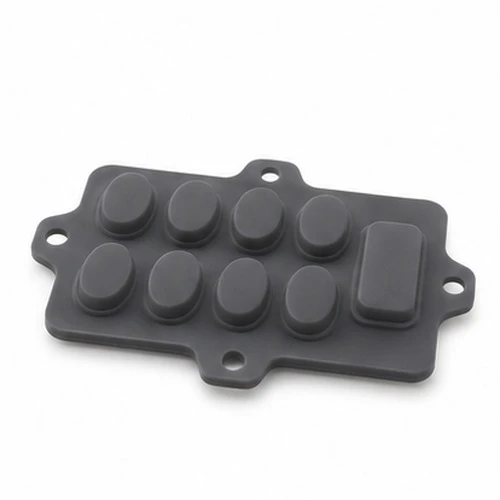


SWKS Seal, with over 10 years experience, is one of the leading custom silicone industrial hmi control panel button membrane manufacturers and suppliers in China. And we also offer the customized service catering to your special requirement. Please be free to buy the rubber products with competitive price from us.
Custom Silicone Industrial HMI Control Panel Button Membrane
SVKS manufactures a silicone button membrane sized for an industrial operator panel to the approved project specification. Please share the installation drawing, working conditions and quantities so that the sample program can be scoped against the intended assembly. The white-background reference images illustrate potential part geometry for discussion.
Product specifications
| Material | Silicone grade per approved specification |
|---|---|
| Processing | Custom rubber molding |
| Component | a silicone button membrane sized for an industrial operator panel |
| Mating interface | the bezel, front plate and underlying switch stack |
| Drawing | STP / STEP / IGS with dimensioned reference drawing |
| Acceptance | the defined force and travel response at each button position |
Align the panel stack
Show the front cutout, the membrane and the switch assembly in the same drawing section. Mark the true mounting datum for the button mat. If an offset or wide key is present, include a separate section for it. For multi-key panels a coordinate layout simplifies comparison between the membrane, overlay, PCB and enclosure, especially when there are several visually similar versions.
Describe the press characteristics
Tell us the expected travel and force profile, how a key is pressed and what counts as a completed actuation. A broad key may respond differently near a corner than when pushed at the center. If operator gloves matter, supply the touch area and test positions. Measure force, return and clearance in the clamped assembly whenever the surrounding hardware shapes the response.
Review background light and legends
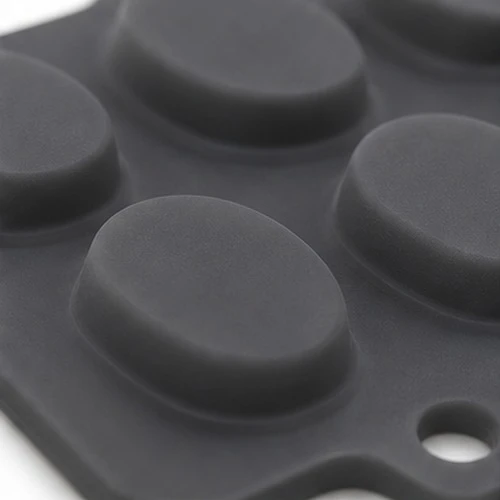
If a panel uses illuminated labels, identify the optical stack and the appearance goal before choosing a color or surface texture. Keep artwork registration separate from the molded key coordinates. Provide a sample overlay or a controlled drawing for any legends, and define a review condition for appearance. The reference image depicts the molded blank so that the button and web geometry are visible.
Define the perimeter interface
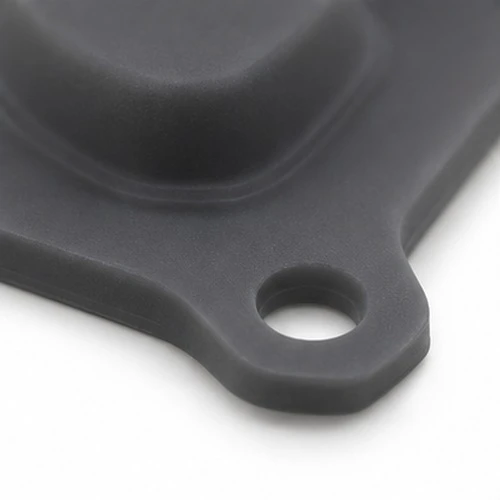
A membrane may include flat carrier edges, mounting holes or a compressed lip around the front panel. Detail the edge that contacts the bezel and any area where the web may touch adjacent hardware. If the panel has a sealing requirement, identify which component provides the interface and provide its qualification method. The assembled panel is the relevant test article for any stated enclosure performance target.
Control flash near moving keys
A small amount of extra material at a pivoting web or along a key sidewall can change the feel of neighboring buttons. Mark acceptable parting regions and critical edges on the drawing. Ask for representative molded parts when approving the surface, travel and tactile response. Cosmetic review is easier when the areas visible to an operator are identified separately from hidden mounting features.
Record variations by panel revision
Capture differences in key legend, actuator height or enclosure thickness under separate drawing or configuration identifiers. A revised switch stack or front plate can change travel even when the outer shape of the membrane appears identical. Mark the approved combination in the first sample report and refer to it when evaluating additional positions or replacement panels.
Sample control begins with the operator overlay
Most panel teams recognize the assembly by its printed overlay. The overlay part number is a useful order reference as long as the released version still identifies the underlying molded button mat. Start with a plan view that distinguishes clear windows, recessed blank areas and active keys. Add limits for registration if a visible graphic has to remain centered over a molded surface. For keys that are intentionally blank on the sample, identify that condition in the approval notes so the evaluator does not reject the surface for missing artwork. If the equipment is offered with different language overlays, record the applicable overlays and compare their mounting and visual treatment before assuming one membrane configuration fits every label set.
Define a reliable button-motion check
Build a test plan around the controls operators actually reach. Use a representative front panel with the same mounting and backing support as production. Establish a probe shape and a controlled approach direction at the key center, then add any off-center locations that matter. Record both where the underlying switch changes state and where the moving key reaches its mechanical limit. The two points can occur at different travels. Some button assemblies also depend on the switch recovery point or the required free clearance after release. Use the same loading method each time so that one result can be compared directly with another. Record the temperature and condition of the membrane if these are part of the project acceptance criteria.
Identify which circuitry belongs in the quote
Silicone membranes can cover discrete mechanical switches, carry conductive contacts where specified, or serve as covers above a separate switch layer. Provide a section through the selected arrangement and identify the components included in the purchase. If the membrane is supplied as a blank molded part, show how the switch stack is located and which surfaces are touched during actuation. When contact pellets, printed layers or other features are required, detail their locations and state which continuity or contact measurements go into the acceptance plan. Share the intended circuit and pad geometry when they affect the membrane design. Keep any electronic assembly testing in scope only if it is included in the quotation.
Prepare a panel stack with representative edge restraint
A sample membrane can work well in a hand-held check and feel different once the surround is tightened. Capture how the front frame, backplate and mounting screws locate and restrain it. Include spacing between fasteners and show how stops or bosses set the closed height. If the design relies on the seal band around a cutout, specify the contour and the assembly sequence instead of asking for a gasket effect from the overall molded piece. During validation, check that the outer web stays seated while a key near a corner is pressed. Identify paint, coating or texture on the enclosure mating surfaces if these influence friction, appearance or compression around the keys.
Use a consistent visual reference for color and texture
Industrial control panels often combine a metal face, molded bezels, protective windows and silicone keys. Assess the finished appearance with the adjacent parts or a defined reference. A gray sample from a standalone mold may look different beside a printed legend, blue indicator or reflective stainless bezel. Use the actual lighting and viewing conditions where practical and note what appearance differences are acceptable before production approval. If a matte key top is required for readability, show its boundaries on the drawing and identify whether the sidewalls and web need the same texture. For custom colors, send a physical reference or the applicable color system and tolerance along with the sample request.
Try the expected operator and maintenance routines
An HMI is repeatedly wiped, handled and pressed in a recognizable sequence. Describe whether keys are used one at a time, pressed in quick succession, or operated through gloves. For a panel that is wiped or washed, list products used during cleaning and provide the relevant concentration, contact time and drying method. An approved design review can distinguish short contact used during routine cleaning from materials kept against the key surface during storage or installation. Identify how the panel is serviced and where technicians may lift the membrane. A retained spare should be labelled with the approved geometry and overlay version so that it can be installed without confusion during a maintenance visit.
Choose inspection points for large and small controls
A membrane with mixed button sizes benefits from an inspection map. Identify an example of each key family, designate which button is checked near an edge, and record clearance around its web and actuator. If the panel contains an especially long button or a separate navigation group, check for interference with the adjacent housing and determine whether it shares a molded support with neighboring keys. Describe where fixture loads should be applied so that handling alone does not compress the piece before its height is measured. Provide a report layout that links button positions to drawing coordinates and note any switch position where the feel target differs. Compare sample pieces using a consistent assembly sequence and clamp condition.
Quote the intended combination of service parts
Tell us whether the membrane will be ordered with the overlay or as a separate replacement, whether the same design serves multiple enclosure versions, and what quantities are expected for pilot and repeat orders. If reusing an existing production tool, identify who controls it and provide samples of the latest approved part. A useful RFQ includes the material expectations, mating stack, label and color requirements, key test data, and any plan for life cycle evaluation. Once the first panel set is accepted, record the part number that procurement will reorder, the configuration the receiving team will inspect, and the reference assemblies used to approve it. Clear configuration records also help evaluate future changes to the PCB or front plate.
See related OEM rubber products for other custom components.
Request a quotation
Email your drawings, trial requirements and estimated order quantities to amanda@tjswks.com. Include the drawing and material revision that the quotation should reference.
Hot Tags: custom silicone industrial hmi control panel button membrane, China, manufacturers, suppliers, customized, price


