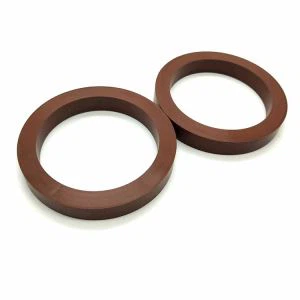
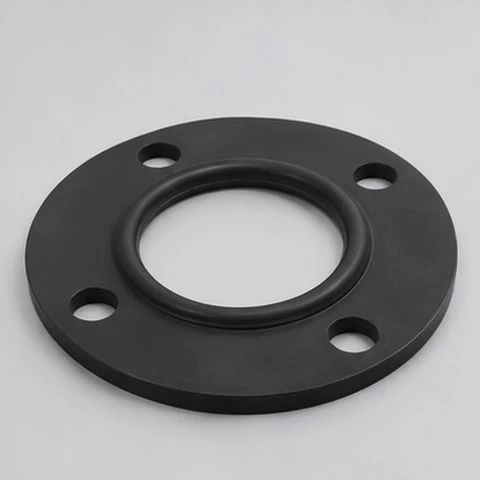


SWKS Seal, with over 10 years experience, is one of the leading custom epdm molded rubber flange gasket manufacturers and suppliers in China. And we also offer the customized service catering to your special requirement. Please be free to buy the rubber products with competitive price from us.
Custom EPDM Molded Rubber Flange Gasket
This drawing-based EPDM flange gasket is produced for the specified flange pair. Common project decisions include whether to support the full gasket face, where to position the sealing bead and how to preserve clearance through the pipe bore.
Start with the bore and flange faces
The opening in this custom EPDM flange gasket is established by the pipeline or equipment bore. The molded bead sits on the flange land and the bolts pass through the surrounding holes. The part can be reviewed for a flat-faced connection, a counterbored face or another drawing-defined interface. Send both flange drawings because their inner edges and face widths can differ. A wider land on one half of the joint cannot protect a bead that overhangs the other half.
Provide a drawing of the flange pair in section and from the bolt side. Mark the reference used to locate the bead diameter relative to the flange bore, and indicate any spot faces, witness marks or interrupted surfaces where gasket contact is expected. For a short run, a complete hardware pair is valuable for verifying concentricity and seating during the sample trial.
How to document joint compression
Specify the intended closed gap wherever the assembly has hard stops. In a joint held together by bolt load, identify the fasteners, flange materials and tightening method. If there is a washer under each bolt, include its dimensions or specification. A tightening sequence that works on a small rigid flange may leave an uneven gap on a larger joint with more flexible faces. Ask the assembler to provide the sequence also used for the sample and qualification test.
At the design review, compare the contact width and the place where the edge of the bead moves during clamping. If its movement is limited by a counterbore, include the depth and the radii at both corners. A recessed gasket can appear positioned correctly before tightening, then rotate if the bolts pull the mating piece sideways. The mounting orientation and ability to see the gasket during assembly both matter to the final fit.
Specifications that identify a molded flange gasket
| Item | Drawing or project input |
|---|---|
| Material | EPDM rubber |
| Processing | Rubber molding |
| Application | industrial water equipment flange connections |
| Geometry | bore and outside diameter, bolt pattern, reference flange face, bead height and compressed thickness |
| Operating inputs | fluid chemistry and temperature, bolt tightening sequence and load, working and test conditions |
| Drawing format | STP, STEP, IGS or PDF with revision and units |
| Acceptance | Critical drawing features, assembly fit and agreed functional checks |
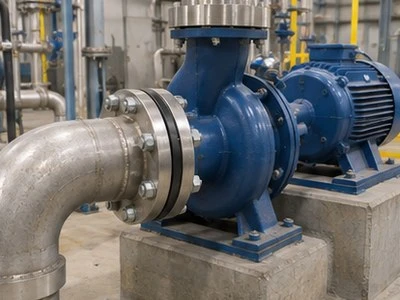 Equipment installation view |
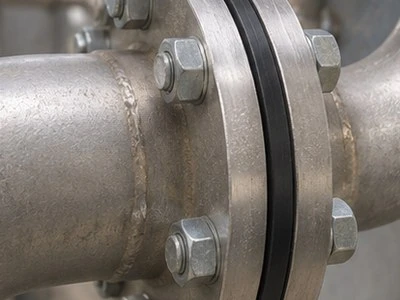 Detail of the installed component |
Locate the sealing bead from the pipe flange
The center opening of a flange gasket should be compatible with the flow path and the geometry of both faces. Mark the location of the molded bead relative to the inner bore. At the bolt circle, record hole sizes and positional tolerances. A sample can look correct on a bench yet sit off-center after the bolts are inserted. Verify that the gasket can align without obstructing the flange opening or being pulled sideways by fastener installation.
Identify whether the equipment uses a full-face or raised-face connection and provide the dimensions of the actual mating surfaces. Confirm whether holes are molded through the gasket and whether the available lands support the full molded cross section. A raised face or step can leave part of the rubber unsupported. When the design uses a compressed stop or built-in groove, include the limiting gap and the intended load direction.
Define the flange joint as an assembly
Fastening practice affects the pressure distribution along the bead. The flange pair, surface finish and fastener sequence used in production should be represented during a fit and sealing trial. If the equipment has dissimilar flange materials, share that information because their response to assembly load may differ. For a replacement, note any damage or corrosion on the existing faces and identify whether the mating parts will be renewed as well.
EPDM is the specified starting material for this drawing-based part. List the fluid including additives and treated water chemistry, where applicable, and describe the highest and lowest service temperatures expected at the joint. Include cleaning or flushing media and the duration of exposure. If the application requires a specific approval for the rubber in contact with the fluid, include its exact designation and have it confirmed for the proposed compound.
Plan an inspection at the bead and bolt holes
Record which edges locate the molded gasket, and calculate how much the holes and bore can move relative to the bead. Inspect the bead height at several locations around the complete ring and agree on acceptable mold witness and flash. A continuous sealing bead should be checked at both the parting line and at changes of section adjacent to molded bolt features. Keep flatness and bead-height measurements tied to the support condition used by inspection.
Use both flange faces in the first sample installation. Check the bore alignment and confirm the gasket stays centered after tightening. If a leakage test is required, identify medium, pressure, temperature, orientation and dwell from the project specification. On teardown, inspect where the bead actually seated and compare its imprint around the joint. Verify that release and replacement remain practical if the connection is opened during maintenance.
Provide the flange face drawings and the assembly clamp requirements with the RFQ. A nominal pipe designation is useful for identification. It does not independently establish the groove, bolt pattern, sealing land or rubber cross section for a custom molded gasket.
Review production features around the complete ring
A molded flange gasket can include a locating rim or a bead that would not be present on a flat cut washer. Identify which features are shared by both faces and which are on only one side. Select the side for demolding marks with the mating surface in mind. If the bead connects to a section that changes thickness, call out the transition in drawing views where it can be inspected independently of the bolt pattern.
Keep the hardware stack with the retained sample reference. Bead shape and material acceptance matter, as does the fit of the molded gasket with the actual bolt heads and flange face. When the customer changes the flange or uses an alternate casting, compare the key section and bolt availability before attempting to use up earlier stock. Drawing revisions make it easier to identify which gasket and flange versions are compatible.
Sampling for a bolted joint
Start by aligning the gasket without clamp load and confirming that the hole pattern and bore sit in the intended relationship. Under the assembly procedure used in production, verify that the part is seated before applying the functional test. During teardown, note compression marks at each bolt sector as well as midway between bolts. If a mark is concentrated near one fastener, check the flange face and assembly sequence before deciding whether to alter the elastomer profile.
For projects that specify a pressure test, provide the test conditions and limits from the equipment specification. Also state whether the joint is opened after the first test and whether a gasket replacement is required when it is reopened. For water service, list additives, flush cycles and any periods when the joint is expected to remain dry. The combination of media and mechanical loading is the basis for reviewing the exact EPDM compound.
Purchasing and spare parts
Include the flange figure or a measured hardware section, bolt-hole count, centers or bolt-circle diameter, bore diameter and estimated quantity. Identify the condition of field equipment if the part is being ordered as a replacement. For recurring supply, keep the flange series and bolt pattern on the purchase reference so that similar-looking rings for different connections do not get mixed during maintenance.
State if the first order is a fit sample, maintenance quantity or a production release. A drawing-based order can include the agreed molded dimensions, compound reference and packaging. Larger diameters may need individual support during storage to preserve the free shape seen at installation.
Distinguish leakage paths before changing the compound
If a sample fails an assembly test, record where the liquid or gas first appears. It can move around the outer flange edge before it becomes visible, so the point where it exits is only one part of the evidence. Photograph the joint before taking it apart and compare the position of the bead with the marks on both faces. Repeat the test only under the agreed conditions using the same flange material and fastener arrangement, so the two results can be interpreted together.
A leak at a chipped face, an incorrectly seated bead or a connection beside the flange can require a different correction. Use the test team's findings to identify whether the part drawing, the surface of the hardware or the installation procedure needs revision. Distinguish marks made during teardown from marks present under load. Keep the before-and-after photographs with the tested gasket and hardware reference when submitting revisions to the supplier.
For a spare gasket, inspect a new or unworn flange if available. A ring cut from a worn joint may no longer record the original bore, outside diameter or bolt hole spacing accurately.
Request a quote
Send the flange and gasket drawings plus the compound specification, service conditions and anticipated order quantity to amanda@tjswks.com.
Hot Tags: custom epdm molded rubber flange gasket, China, manufacturers, suppliers, customized, price